
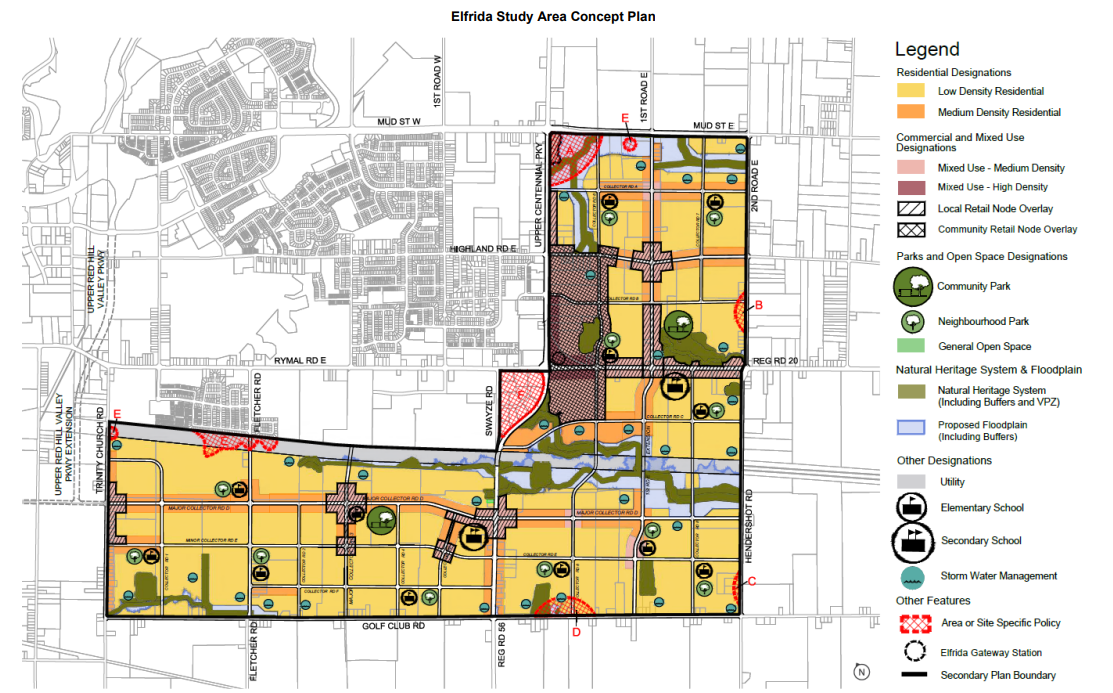
Elfrida - 2987 acre urban boundary expansion
Low density McMansions are indicated in yellow on the landowner
consortium’s proposed secondary plan.
Hamilton currently has a $5.2 billion deficit in infrastructure repair and replacement. Permitting more sprawl will only increase that deficit.
TAKE ACTION BELOW - Council will vote on Aug 25, 2026
Emails to Councillors and Clerk due by noon, Monday Aug 24, 2026
Talking Points and contacts below
Elfrida land speculator developers (listed here) want City Council to approve their massive 3000 acre low density Secondary Plan at the August 25, 2026 Planning Committee meeting. Additionally, they have appealed the City’s denial of their application to expand Hamilton’s urban boundary to the Ontario Land Tribunal (OLT) and won but we don’t have to approve their secondary plan.
Appeals are now possible under Doug Ford’s new Bill 185 “Cutting Red Tape to Build More Homes Act, 2024”
In response to massive public support, Hamilton City Council has voted to maintain a firm urban boundary repeatedly since 2021 , choosing to build a mix of housing types and price points close to jobs, transit and amenities, inside our current urban boundary, on already serviced land.
August, 2026 actions:
Please submit your comments to Council and Clerk AGAINST the Elfrida Secondary Plan urban expansion application. Councillors will vote on this proposal on August 25, 2026.
Watch the very informative video recording of the City’s June 11 virtual open house here.
Read all the materials, studies, maps and plans submitted by the Development consortium at the City’s website here.
Urge Councillors to DENY the proposed secondary plan and be sure to copy the clerk so your email is added to the agenda. Contacts here.
Don’t forget to start your email by indicating your ward to catch your Councillor’s attention.
Subject line: Elfrida Secondary Plan - Aug 25, 2026 Planning Committee
Talking points for your email to Council. Please use your own words.
Please vote to DENY the application for the following reasons:
The proposal does not comply with the Provincial Planning Statement which states:
(Already existing) Settlement areas shall be the focus of growth and development. Within settlement areas growth should be focused in, where applicable, strategic growth areas including major transit station areas. (There are no major transit station areas on Elfrida farmland and won’t be for decades.)
Planning authorities shall support General intensification and Redevelopment to support the achievement of complete communities, including by planning for a range and mix of housing options and prioritizing planning and investment in the necessary infrastructure and public service facilities.
Land use patterns within settlement areas should be based on densities and a mix of land uses which:
1. Efficiently use land and resources.
2. Optimize existing and planned infrastructure and public service facilities
Planning authorities shall support General intensification and Redevelopment to support the achievement of complete communities, including by planning for a range and mix of housing options and prioritizing planning and investment in the necessary infrastructure and public service facilities.
Further reasons for denial
Elfrida urban expansion as a whole would put the city in a negative overall financial position as per Watson and Associates' Peer Review of Elfrida's Fiscal Impact Study
2988 acres of prime Hamilton farmland, wetlands and woodlots should not be sacrificed for low density sprawl development
Transit would not be extended to Elfrida sprawl subdivisions for decades, if ever, making them car-dependent and increasing emissions in a climate emergency
Hamilton has hundreds of acres of developable, serviced land, owned by others, already available inside the urban boundary, that should be prioritized
The city has undergone zoning changes that allow much more density within the urban area, negating the need for sprawl
Directing growth to sprawl subdivisions and away from the downtown core would risk derailing the success of the LRT and planned densification along the B line.
Over 18,000 Hamiltonians participated in the City's Growth Survey in 2021, an unprecedented amount of feedback. Of the respondents, 90.4% chose option 2 - no urban expansion.
Hamiltonians recognize our city has a $5.2 Billion funding shortage (page 5 of PW25036) for infrastructure repair and renewal that has been accumulating since the early 2000s. In short, we cannot pay for the infrastructure we currently have. Building more roads, bridges, water pipes etc. to service sprawl development will only tax Hamiltonians more over the lifetime of that infrastructure, and enrich land speculators in the short term.
The City had Elfrida's Fiscal Impact Study peer reviewed with this result: Watson and Associates determined that urban boundary expansion would result in a fiscal loss for the City. This alone is reason enough to recommend denial of this secondary plan, in addition to the loss of prime farmland and wetlands.
Elfrida expansion was before the Planning Committee on June 25, 2025 at Item 8.2. From the Staff report: The peer review questioned several assumptions of the Financial Impact Analysis. Most notably, that it did not estimate the long-term operating and replacement costs based on average expected useful life by asset class. The peer review states that “incorporating these costs into the fiscal impact results in a negative overall position, given the magnitude of the work required to service this population/development area”. Page 19 of PED25179 (staff report): https://pub-hamilton.escribemeetings.com/filestream.ashx?DocumentId=457526
The Peer Review also noted that omissions, errors and lack of accounting for the forever costs of repairing, replacing and disposing of infrastructure as it ages out was not considered. Hamilton's existing $5.2 Billion infrastructure spending deficit was not considered. This is the crux of the argument against sprawl: the immediate tax influx from new development is dwarfed by the forever costs of servicing infrastructure for its lifetime. Sprawl development does not pay for itself and the crushing infrastructure deficit has already fallen to residents.
Hamilton has already demonstrated that increasing the City's prior intensification target of 40% to the No Urban Boundary Expansion intensification rate of 80% is achievable through multiple rezoning efforts that now permit many more types of housing in the city.
2023 = 90% intensification rate achieved
2024 = 68% intensification rate achieved
2024 = 84% intensification rate achieved
History
Staff and consultants have confirmed that urban expansion would be financially detrimental to the City. From the staff report: “The City had the applicant’s Fiscal Impact Assessment peer reviewed by Watson & Associates. Based on the findings from the peer review, staff concluded that the applicant had not shown that the proposed urban boundary expansion is financially viable (i.e., the proposal will negatively affect the City’s fiscal position).” https://pub-hamilton.escribemeetings.com/filestream.ashx?DocumentId=457526
On June 25, 2025, Staff recommended that Urban Hamilton Official Plan Amendment Application UHOPA-25-007 by Bousfields Inc., on behalf of the Elfrida Community Builders Group Inc be DENIED for several reasons outlined in the Staff report. Council voted unanimously in favour of the Staff recommendation for denial. https://pub-hamilton.escribemeetings.com/filestream.ashx?DocumentId=457526
Through zoning changes that now allow many more types of housing beyond single family homes, staff have confirmed that Hamilton can meet its housing targets by adding much more densification within the current urban boundary, eliminating the need for more land. https://www.hamilton.ca/build-invest-grow/planning-development/zoning/residential-zones-project
The City of Hamilton exceeded its 80% Residential Intensification Target in 2023 with an intensification rate of 90%. Hamiltonians embrace a growth strategy of infill housing and densification within existing neighbourhoods, near transit, jobs and amenities. https://pub-hamilton.escribemeetings.com/filestream.ashx?DocumentId=425614
Based on current data and approved levels of service, the City of Hamilton faces a 10- year Infrastructure Funding Gap of $5.2 billion. Adding more sprawl infrastructure on distant farm fields away from transit, jobs and amenities will only worsen that burden. https://pub-hamilton.escribemeetings.com/filestream.ashx?DocumentId=455835
A mail-out survey was distributed to households in Hamilton in late June/early July 2021 to ask for opinions about how the City of Hamilton should grow to the year 2051. An absolutely unprecedented total of 18,387 survey responses were submitted to the City through mail and email up to the survey deadline of July 23, 2021. Option 2 “No Urban Boundary Expansion” was the clear choice of Hamiltonians with 16,636 or 90.4% or responses. https://www.hamilton.ca/build-invest-grow/planning-development/growth-planning-grids/grids-2mcr-urban-growth-survey
Urban expansion would destroy thousands of acres of prime one farmland and be detrimental to our food security, climate change reduction and mitigation goals, urban forest strategy, wetland protection goals, affordable housing strategy, and jeopardize Light Rail Transit success by directing growth far away from the proposed LRT line.
Jan 2026 update:
There are now five UBE appeals at the OLT. Three of them, Elfrida, Twenty Road West and White Church have common issues and the City’s request to combine those issues into one hearing for all three landowner groups has been granted by the OLT. That consolidated hearing will take place over two weeks in April 2026.
Everyone is encouraged to tune in and watch the hearing. Your camera and mic will be off, but your presence shows the OLT that Hamilton is watching. The link to the GoTo meeting (similar to a zoom meeting) is below. You can download the GoTo app or watch in your web browser.
Monday, April 13, 2026 - May 1, 2026.
Join the video event:
https://meet.goto.com/558205565
Access code: 558-205-565
Issue 1: Which population forecasts and methodology should be applied to the proposed urban boundary expansions, in accordance with Sections 2.1.1 and 2.1.2 of the Provincial Planning Statement, 2024?
Issue 2: Is an urban expansion(s) warranted for the City of Hamilton to accommodate an appropriate range and mix of land uses to meet projected needs as per Sections 2.1.3 and 2.1.4 of the Provincial Planning Statement, 2024?
Issue 3: Is there a need for additional urban land to accommodate an appropriate range and mix of land uses as per Section 2.3.2.1a) of the Provincial Planning Statement, 2024?
Issue 4: Will the proposed urban boundary expansion(s) impact the City of Hamilton’s ability to meets its residential intensification and redevelopment targets, including the intensification distribution policies set out in Sections A.2.3 and B.2.4.1 of the Urban Hamilton Official Plan?
Issue 5: Will the proposed urban boundary expansion(s) result in intensification targets not being achieved within the current approved boundary, resulting in under-utilization of existing and planned infrastructure? For example, will the urban boundary expansion impact the City of Hamilton’s goals to meet provincial density targets in the Major Transit Station Areas?